
Turning Coconut Shells into Packaging and How ISO 9001 Helps with Circular Innovation
- Jul 6
- 4 min read
Brought to you by IBEC Intelligence
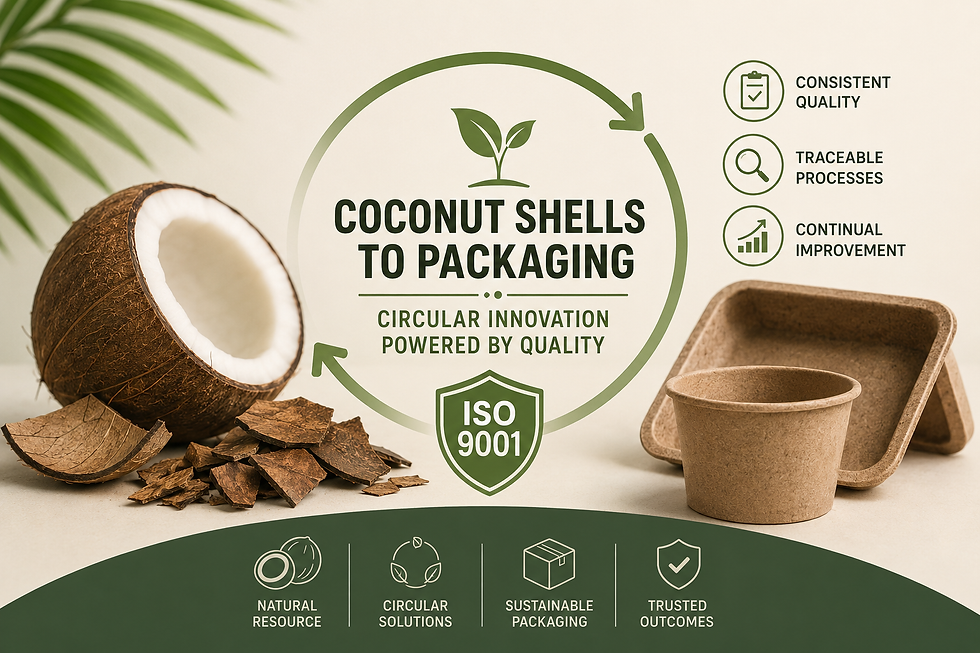
Some sustainability ideas sound great in theory until you ask the practical question if it can be produced consistently and safely, delivering reliable performance.
That question is exactly what makes the recent interest in coconut shell-based packaging so compelling. Coconut shells are an abundant agricultural byproduct, and researchers have explored ways to convert coconut-derived materials, such as cellulose, cellulose nanofibers, and other composites, into biodegradable or compostable packaging components and films. For example, studies have investigated coconut shell–based biopolymers for biodegradable films suitable for packaging applications.
But innovation doesn’t scale on optimism alone. It scales when organizations build systems that can handle variability, testing, traceability, and improvement, especially when the output is something people rely on in their daily lives. And packaging fits that category.
Why Coconut Shells Are Getting Attention
Packaging is often a major contributor to waste because it’s designed for short-term use and disposal. The U.S. EPA describes packaging as products used to wrap and protect goods that are generally assumed to be discarded when the contained products are purchased and disposed.
So, the sustainability opportunity is clear. If we can turn packaging inputs from “single-use virgin materials” into circular inputs, we reduce environmental burden while supporting more resilient supply chains.
Coconut shell materials are attractive because they can be processed into packaging-oriented material forms, ranging from biodegradable composites to packaging films and other biodegradable packaging concepts.
Innovative Companies That Transform Discarded Coconut Shells into Packaging
Companies like CocoPallet in the Netherlands are proving that agricultural waste can replace traditional timber and plastics at scale. By compressing coconut husks using only heat, pressure, and the natural lignin found in the fibers, CocoPallet produces durable shipping pallets that eliminate the need for synthetic resins and reduce global reliance on wood.
In South Korea, Polyphenol Factory is pushing the boundaries even further by partnering with KAIST to engineer rigid cosmetic and personal care bottles made from polyphenol rich coconut fibers, an approach that merges nanotechnology with circular design to replace petroleum based plastics.
In the United States, innovators like Whole Tree, Inc. and Compadre are turning coconut fibers and other agricultural byproducts into molded protective inserts that can replace styrofoam and other non recyclable packaging. Together, these companies demonstrate how coconut waste can fuel a more resilient and regenerative packaging ecosystem. Beyond the environmental benefits, reduced deforestation, lower emissions, and the elimination of toxic resins, this model also strengthens local economies in coconut producing regions by creating new revenue streams for farmers. It’s a powerful example of how circular thinking can turn a global waste challenge into a sustainable materials revolution.
Where the Ingenuity Really Lives – In the System
On paper, it’s easy to say “Use discarded coconut shells for packaging.” In reality, coconut shells aren’t uniform. Their chemical composition, particle size, moisture content, and processing outcomes can vary by harvest, region, storage, and pre-treatment methods. So it’s a far more complex proposition that it appears on the surface.
This lack of uniformity and lack of material consistency means a coconut shell packaging initiative must answer questions like:
Will batches perform consistently in terms of strength, barrier properties, appearance?
How do you control processing conditions when inputs vary?
What testing proves the packaging meets its intended performance?
How do you ensure traceability from input to finished goods?
What happens when something fails and how fast do you correct and prevent recurrence?
This is the part many “green material” projects underestimate. Sustainability is not only about what the material is, it’s about how it’s managed.
ISO 9001 Has the Power to Turn Circular Materials into Repeatable Outcomes
This is where ISO 9001 becomes more than paperwork, it becomes an innovation accelerator when used correctly.
ISO 9001 is built around disciplined management of processes, evidence, and continual improvement. In practice, organizations that align with ISO 9001 principles tend to strengthen the “innovation lifecycle,” especially through:
Process Control and Repeatability (so production outcomes are stable across batches)
Measurement and Monitoring (so you know what’s working, not just what’s hoped)
Corrective Action and Continual Improvement (so defects become learning instead of repeat problems)
Corrective action and continual improvement are fundamental mechanisms in ISO 9001’s quality management approach, driving organizations to identify nonconformities, address root causes, and improve effectiveness over time.
In other words, the proper use of ISO 9001 helps ensure coconut shell packaging isn’t just a promising prototype, and that it becomes a product that can consistently be trusted, reproduced, and improved.
Circular Innovation Needs Trust
There’s also a stakeholder side to this. Packaging touches food and consumer goods, so it must perform reliably. Even if the environmental case is strong, the market still demands safety, consistency, and performance.
When organizations combine circular materials, like coconut shell-derived inputs, with a strong quality management system like ISO 9001, they build the trust needed for broader adoption across manufacturers, regulators, supply chains, and consumers.
Using discarded coconut shells for creating packaging is a smart sustainability direction because it’s based on real waste streams and real material research. But the true breakthrough happens when teams treat the work like an engineered system to create something that is measurable, controlled, tested, and continuously improved.
That’s the intersection where IBEC can help, helping your organization achieve certification, enabling you to turn ambitious sustainability initiatives into management systems that deliver outcomes you can stand behind.
Speak with our IBEC experts, to get on the path of ISO 9001 Certification.


Comments